
'I think some of us, like Mukesh Ambani, myself and those of us who head industrial units, ought to really focus on what we can really do to make the world a safer place, maybe 50 or 100 years from now.' 'For instance, how can we deal with climate change and global warming, right now?' 'The effects of it may not be felt now; in fact, we may pay a price for it today, but it will help the generations to follow.'

With Indian bluechips giving nearly 17 per cent returns during the period, FIIs are bullish on good returns from emerging markets, like India.

Debates on changing the name of India to Bharat continue to spark a crisis of identity without answering moot questions that stare us in the face. Ramesh Menon asks a few of those questions that do not have easy answers.

Delay in the recovery in earnings has led Macquarie, Barclays and Ambit to downgrade Indian shares over the last few days.

With the government clearing the decks for direct listing at the Gujarat International Finance Tec-City (GIFT City) International Financial Services Centre (IFSC), issuers will wait for the ecosystem to develop further before firming up their listing plans. In the meantime, most companies may continue to prefer listing in the onshore market, even as the new avenue provides key benefits such as tax waivers and reduced foreign exchange risk. Sources said that a few key things need to be ironed out further.

Unsubstantiated and illogical opinions, delivered freely from within or abroad, could not destroy the democratic nature of the country, he added.

The share of foreign loans in total Adani group debt portfolio dropped to 61 per cent by September 2023 from 63 per cent as of March 2023, as the group repaid part of its foreign loans and refinanced part of older loans. The share of Indian lenders, on the other hand, rose to 39 per cent in the total debt pie in September 2023 from 37 per cent in March after a report by US-based short seller Hindenburg Research in January last year, which led to volatility in the share prices of group companies. The group's total debt remained static at Rs 2.26 trillion in the same period.

Olympic gold-medallist shooter Abhinav Bindra on Thursday requested all those who are part of the sports ecosystem to treat athletes like human beings and not medal-winning robots.
Share rises further to 73 per cent from 66 per cent last year; Some overseas i-banks seen scaling down operations

New Delhi has reached out to Moscow while waiting for a new president in Washington. New Delhi knows well that in international relations, there are no permanent friends or foes, only permanent national interests, points out Dr Rup Narayan Das.

'We need more support from states to back budding talents from not-so-affluent families.'

Asia Securities Industry & Financial Markets Association (Asifma) has raised concerns about the Securities and Exchange Board of India (Sebi) proposal to introduce a T+0 settlement cycle. The industry association of top foreign portfolio investors (FPIs) has stated that this move could give rise to several issues, including the bifurcation of the market, liquidity fragmentation, and deterioration of market quality. In a discussion paper floated last month, Sebi has proposed a separate same-day settlement cycle that will run parallel to the existing T+1 cycle, where trades are settled the next day.
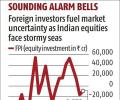
Foreign portfolio investors (FPIs) have withdrawn Rs 25,305 crore from domestic markets since September. FPIs were net sellers in the first two months of 2023, but from March to August, they purchased equities worth Rs 1.7 trillion. This selling trend has caused the National Stock Exchange Nifty Index to decline by 3.2 per cent from its September highs. FPI selling initially began in September as profit-taking but intensified due to rising US bond yields and uncertainty regarding the rate hike trajectory.

Engagement with neighbours is a strategic imperative, and not an option, asserts Rup Narayan Das.

In the first such initiative, the Bharatiya Janata Party has invited the ruling and Opposition parties from around the world to witness the Lok Sabha elections in India first-hand.

From the Sensex basket, ITC, Kotak Mahindra Bank, Bharti Airtel, State Bank of India, Asian Paints, Tech Mahindra, Reliance Industries and Nestle were the major gainers. Maruti, HDFC Bank, Larsen & Toubro and Mahindra & Mahindra were among the laggards.

Foreigners intending to work in NGOs, carry out research work on human rights and environment issues will have to face stricter scrutiny of their visa applications after detection of several incidents of alleged misuse of these provisions.

The ongoing second quarter earnings, movement of oil benchmark Brent crude and the uncertainty in the Middle East would dictate terms in the domestic markets this week, analysts said. Furthermore, the activities of Foreign Institutional Investors (FIIs) will also influence trading in the markets. "A slew of earnings reports from heavyweights expected this week will significantly impact market direction.

These entities did not apply for renewal of their FCRA licence. In addition, the Union home ministry also rejected renewal applications of 179 organisations, officials said.

The ever-astute Ravi Matthai, Director of Indian Institute of Management, Ahmedabad in 1971, offered me a basic salary of Rs 1,000 per month on my return from the United States. I doubt if IIMA could hire a faculty member at Rs 55,000 per month today! points out Dr Shreekant Sambrani.

When the country is full of confidence and resolve, and intellectuals of the world are optimistic about India, talk of pessimism, showing the country in poor light and hurting the morale of the country also takes place, he said at the India Today Conclave.

We asked colleagues, present and past, to reflect on a man who has made such a difference to their lives and careers. Here it is then, a rich collection of memories that offer enchanting glimpses of the enigmatic Ajit Balakrishnan.

'We emphasise the importance of not basing investment decisions solely on electoral outcomes.' 'Instead, focusing on investing in high-quality businesses capable of prospering regardless of the political landscape is paramount.'

The State Bank of India is likely to finalise the acquisition of two banks in Asia and Africa in six to eight weeks, its chairman A K Purwar said on Tuesday.

Foreign portfolio investors' (FPIs') shareholding in NSE-listed companies fell 51 basis points sequentially to 17.68 per cent in the quarter ended March 31, 2024, according to data compiled by PRIME Database. This is the lowest FPI shareholding since December 2012. From the recent peak of 21.21 per cent at the end of December 2020, FPI shareholding is down 353 basis points.
A military official has said that the attack was also sabotaged because the grenades were defective.

Nestle, State Bank of India, Power Grid, Tata Steel, Larsen & Toubro and Mahindra & Mahindra were the other major gainers. In contrast, Tech Mahindra, Axis Bank and Reliance Industries were the laggards.

The 'aura of invincibility' around Prime Minister Narendra Modi has been 'shattered' by the Indian voters who gave the Opposition a new lease on life, this is how the international media described the outcome of India's general elections.

Sir Osborne Smith was the first governor of the Reserve Bank, serving from April 1, 1935, to June 30, 1937.

Citi Bank on Wednesday joined the list of foreign banks that have exited the retail banking business in India as the US-based banking giant announced selling its consumer banking portfolio to Axis Bank for an estimated Rs 12,325 crore. Global banking majors such as ANZ Grindlays, RBS, Commonwealth Bank of Australia have scaled down their operations in India. In a mega-deal announcement on Wednesday, Axis Bank and Citibank said their boards have approved acquisition of Citibank's consumer businesses in India by Axis Bank.

Gandhiji asked me if I had sufficient warm clothes in view of the coming cold season. I said yes. But he verified my statement by asking Miraben to search my bag to make sure. Such was Gandhiji.

The fundamental construct of India's neighbourhood policy still needs to be what Vajpayee postulated, Manmohan Singh embraced, and Modi energised. It's just that we need to junk domestic politics and excessive religiosity, while acquiring much humility and a renewed respectfulness towards our neighbours, recommends Shekhar Gupta.

"Everything may look normal in Kashmir. Everything may look normal here. We may be celebrating the victory, although of course some people believe that that victory or that success of 2024 was perhaps only marginal, perhaps a lot more needs to be done," he said.

Shringla, a 1984 batch officer of the Indian Foreign Service, is considered an expert on India's neighbourhood and is currently serving as envoy to the US.
Riding on a bull run, equity investors became richer by Rs 128.77 lakh crore in the 2023-24 fiscal, driven by robust fundamentals of the Indian economy, increased investment inflows and promising corporate earnings. After a muted performance in 2022-23, equity markets made a remarkable recovery in FY24, giving handsome returns to investors. The 30-share BSE Sensex climbed 14,659.83 points or 24.85 per cent in 2023-24.
Indian equity markets have a limited upside potential in the near-term as they negotiate the ensuing cyclical slowdown, wrote analysts at Nomura in a recent coauthored report led by Saion Mukherjee, their managing director and head of equity research for India. He, however, believes that the foundations are in place for sustainable growth over the medium-to-long term, and hence suggests a 'buy on dips' strategy to equity investors. As an investment strategy, Nomura prefers domestic-oriented sectors and companies over exporters, and prefers stocks that provide valuation comfort. Industrials and banks are their overweight sectors, while IT services and consumer discretionary are their underweight sectors.

'The good news is that money continues to flow into India-focussed offshore funds.'

Prime Minister Narendra Modi on Tuesday told Russian President Vladimir Putin that a solution to the Ukraine conflict is not possible on the battlefield and peace efforts do not succeed in the midst of bombs and bullets even as he flagged concerns over a missile strike on a children's hospital in Kyiv.

Equity and oil markets can breathe easy for now, as the developments in Russia are unlikely to trigger a runaway rally in crude oil prices, said analysts. India, which imports nearly 80 per cent of its crude oil requirement, has been dependent on cheap Russian oil over the past few months to keep inflation - a sore point for the equity markets - in check. For the Indian markets that are expected to remain volatile amid these developments, analysts believe, the progress of monsoon, fund flows - both foreign institutional investor (FII) and domestic - and the upcoming corporate earnings season back home remain key.
 © 2026 Rediff.com - Advertise with us - Disclaimer - Privacy Policy - Sitemap - Feedback - About us - Terms of use - Grievances